





Insights
Building a Website Customers Can Trust
A trustworthy website helps customers understand your business and take the next step.
Retenvo Team ·
A first impression that answers real questions
A customer who finds your business online is often trying to make a quick decision: are you the right people to help, and how can they reach you? A polished appearance helps, but trust grows when the website clearly explains what you do, who you serve and what happens next.
Start with the questions your customers already ask. Describe your services in everyday language, provide accurate contact details and make it easy to find your location or service area. A clear website can make a small business feel approachable without pretending to be something it is not.
Make confidence part of the experience
Check that your website works on a phone, that text is easy to read and that links and forms work as expected. Include genuine examples of your work or testimonials only when you have permission to use them. Keep opening hours, team details and service information current.
Security and privacy deserve attention too. Use a secure connection, collect only information needed for enquiries and explain how people can contact you about their information. A website earns confidence through many small, consistent choices.
Keep the conversation going
Before launch, ask someone unfamiliar with the business to find a service and send an enquiry. Notice where they hesitate. After launch, review questions from customers and update pages that leave people confused. Retenvo helps organisations plan and build websites around these real customer journeys.
Putting the ideas into practice
A prospective customer lands on a service page and wants to know whether the business can help with a specific job. The following example shows how the team could turn the advice into a practical plan. The details will differ for each organisation, but the sequence gives everyone a shared starting point.
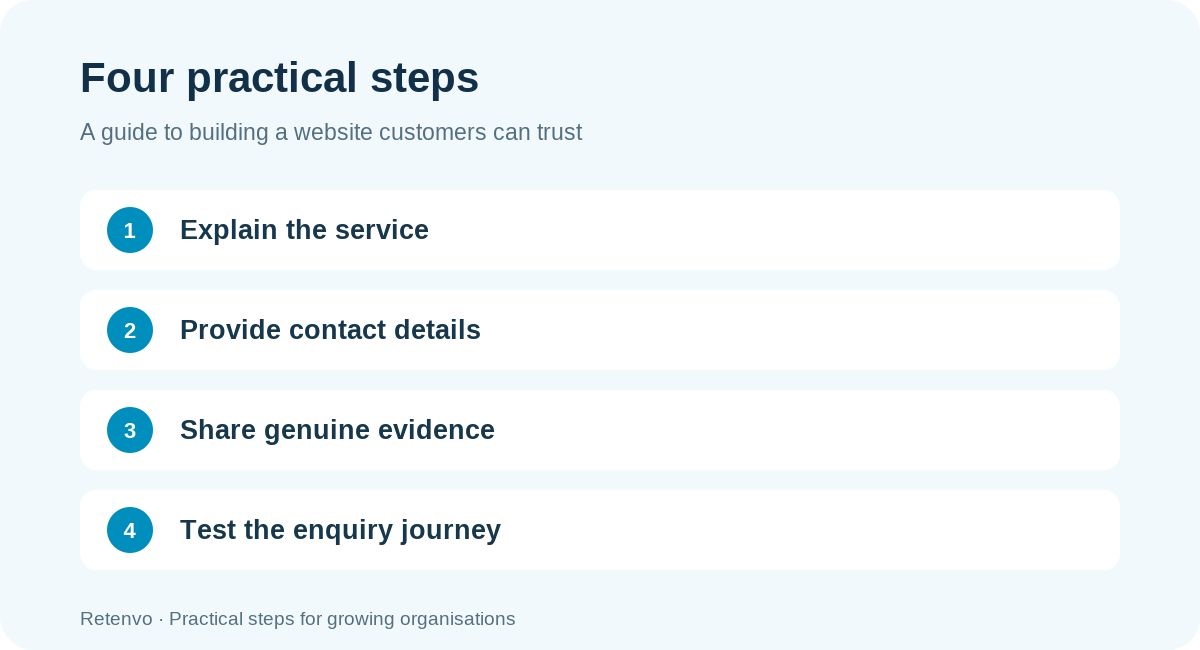
Review the experience from discovery through follow-up. A working page is only useful when the information is current, the next step is clear and enquiries reach someone who can respond.
- Find the page. Describe the service, the area you cover and the type of customer you serve in plain language near the top of the page.
- Understand the offer. Show accurate contact details and explain what happens after an enquiry is sent.
- Take the next step. Use real work samples or testimonials only when they are accurate and you have permission to share them.
- Get a response. Check that the page and enquiry form work on a phone and that someone monitors incoming requests.
What to review before a website goes live
Content and navigation: Can a visitor identify what you offer and find the relevant page without knowing your internal department names? Check headings, links, contact details and service areas with someone who did not write the content.
Accessibility and mobile use: Read the page on a small screen, use a keyboard to move through navigation and forms, and check that text and controls remain clear. Describe meaningful images and make sure the page does not rely on colour alone to communicate important information.
Enquiries and maintenance: Send a test enquiry and confirm that it reaches the right person. Assign an owner to review content, contact details, broken links and changes to the business after launch. If you are replacing an existing website, plan redirects for pages whose addresses change.
Explore our services or contact the Retenvo team to discuss your needs.