





Insights
Choosing a Domain Name for Your Business
A practical guide to choosing and managing a domain name that customers can remember and trust.
Retenvo Team ·

A domain name is the address people use to find your website. It might appear on a business card, an invoice, a sign or the side of a delivery vehicle. Choosing one is a small decision with a long life: customers may continue to use it long after the first version of your website has changed.
The best domain is one that suits your business, is easy for people to use and can remain under your control as your organisation grows.
Start with a name people can remember
Think about the words customers already use to identify your business. A short, recognisable name can be easier to type and share than a long phrase filled with difficult spelling or unnecessary punctuation.
Say the name aloud to a colleague and ask them to write it down. If several people spell it differently, consider whether there is a clearer option. Also check how the name reads without spaces; combinations of ordinary words can sometimes look confusing when written together.
Your domain does not have to describe every service you offer. A name that reflects your business can give you room to add new services without changing your address each time.
Check availability and suitability
Once you have a shortlist, check whether each name is available through a domain registrar. Consider the domain extension as well: the part that comes after the final dot. Choose an option that makes sense for your audience and business, and compare the registration and renewal costs before deciding.
Availability alone does not mean a name is appropriate. Check whether it could be confused with another organisation or conflict with an existing brand. If you are unsure about rights to a name, seek suitable legal advice before investing in it.
Avoid relying on a name simply because it resembles a competitor’s. Your website should help people find and recognise your own business.
Keep ownership and renewal clear
A domain name needs ongoing management. Register it using contact details your business can access, keep those details current and understand who controls the registrar account. If someone else registers the domain on your behalf, agree in writing on ownership and how access will be transferred or shared.
Note the renewal date, make sure payment information stays current and consider renewal reminders. Losing control of a domain can interrupt a website and any email addresses connected to it.
Protect the account with a strong, unique password and any additional security options offered by your registrar. Limit access to trusted people who need to manage it, and keep a record of where your domain and website are managed.
Plan for the website behind the address
A memorable domain helps customers find you, but what they find next matters just as much. Your website should explain your services, work well on a phone and make it easy for people to contact you. If you already have a domain, share those details with your web team before starting a new project so the transition can be planned carefully.
Putting the ideas into practice
A growing catering company wants an address customers can remember when they hear it over the phone. The following example shows how the team could turn the advice into a practical plan. The details will differ for each organisation, but the sequence gives everyone a shared starting point.
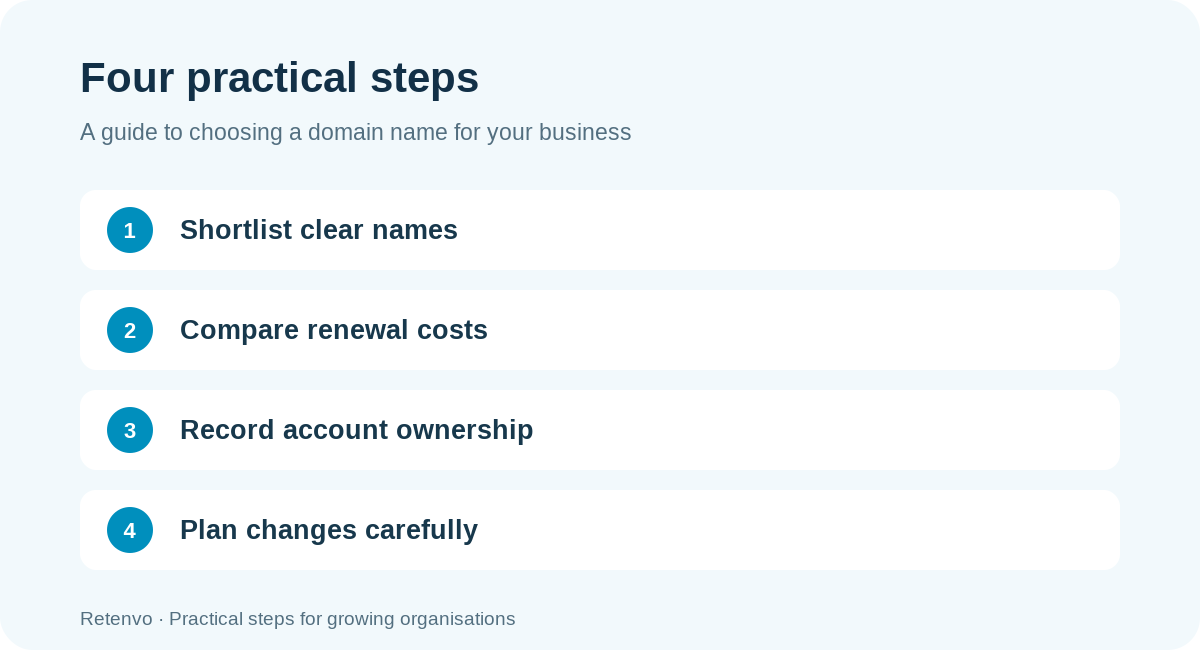
Review the experience from discovery through follow-up. A working page is only useful when the information is current, the next step is clear and enquiries reach someone who can respond.
- Find the page. Write down two or three names that resemble the business name, and check whether each is easy to pronounce and spell.
- Understand the offer. Compare the initial registration price with the renewal price, including any optional services, before purchasing.
- Take the next step. Record the registrar, account owner and renewal date in a place the business can access if a staff member leaves.
- Get a response. Before changing an existing domain, list the website pages and email addresses that depend on it and plan the transition with your provider.
What to review before a website goes live
Content and navigation: Can a visitor identify what you offer and find the relevant page without knowing your internal department names? Check headings, links, contact details and service areas with someone who did not write the content.
Accessibility and mobile use: Read the page on a small screen, use a keyboard to move through navigation and forms, and check that text and controls remain clear. Describe meaningful images and make sure the page does not rely on colour alone to communicate important information.
Enquiries and maintenance: Send a test enquiry and confirm that it reaches the right person. Assign an owner to review content, contact details, broken links and changes to the business after launch. If you are replacing an existing website, plan redirects for pages whose addresses change.
Retenvo helps businesses plan and build websites around the people they want to reach. Explore our web design and development services or contact our team to discuss your website.