




Product
From Paperwork to Progress: How SchPage Helps Schools Work Better Together
Discover how SchPage helps schools and tertiary institutions organise admissions, records, fees and academic work around the people they serve.
Retenvo Team ·

It is Monday morning, and the school office is already busy. A parent has arrived to ask about an admission form. A teacher needs an updated class list. The bursar is checking a payment. A school leader wants to know which students have not yet completed registration.
None of these requests is unusual. They are simply part of running a school. But when the information needed to answer them lives in different exercise books, filing cabinets, spreadsheets and phones, ordinary work can quickly become exhausting.
The same story plays out on a university or polytechnic campus in a different way. A student is trying to complete course registration, a department is organising its timetable, and an administrator is looking for a document submitted during admission. Each person needs information, and each delay can affect someone else’s work.
SchPage is built to help educational institutions bring these activities together. With SchPage K12 for nursery, primary and secondary schools and SchPage TEdu for tertiary institutions, the goal is to make everyday administration more organised, more connected and easier for people to navigate.
The problem is bigger than paperwork
Paper records are not automatically a sign that a school is doing something wrong. Many institutions have built strong communities and supported generations of learners while relying on notebooks, files and familiar routines.
The difficulty comes when an institution’s needs outgrow the systems holding its information. As more students enrol, more staff join and more activities happen at once, the cost of disconnected records becomes harder to ignore.
Consider what can happen:
- The same student information is entered in several places, creating different versions of a record.
- An admissions officer cannot quickly tell which application needs attention.
- A teacher spends hours checking calculations before report cards can be prepared.
- A parent calls repeatedly because a fee payment has not yet been confirmed.
- A lecturer, student and administrator work from different versions of a schedule.
- Important information depends on one staff member knowing where to find it.
These are not just administrative inconveniences. They affect people’s time, confidence and experience of the institution. A delayed answer may be a small interruption for one office, but it can mean uncertainty for a family waiting for news or a student trying to complete registration.
What a more connected school can look like
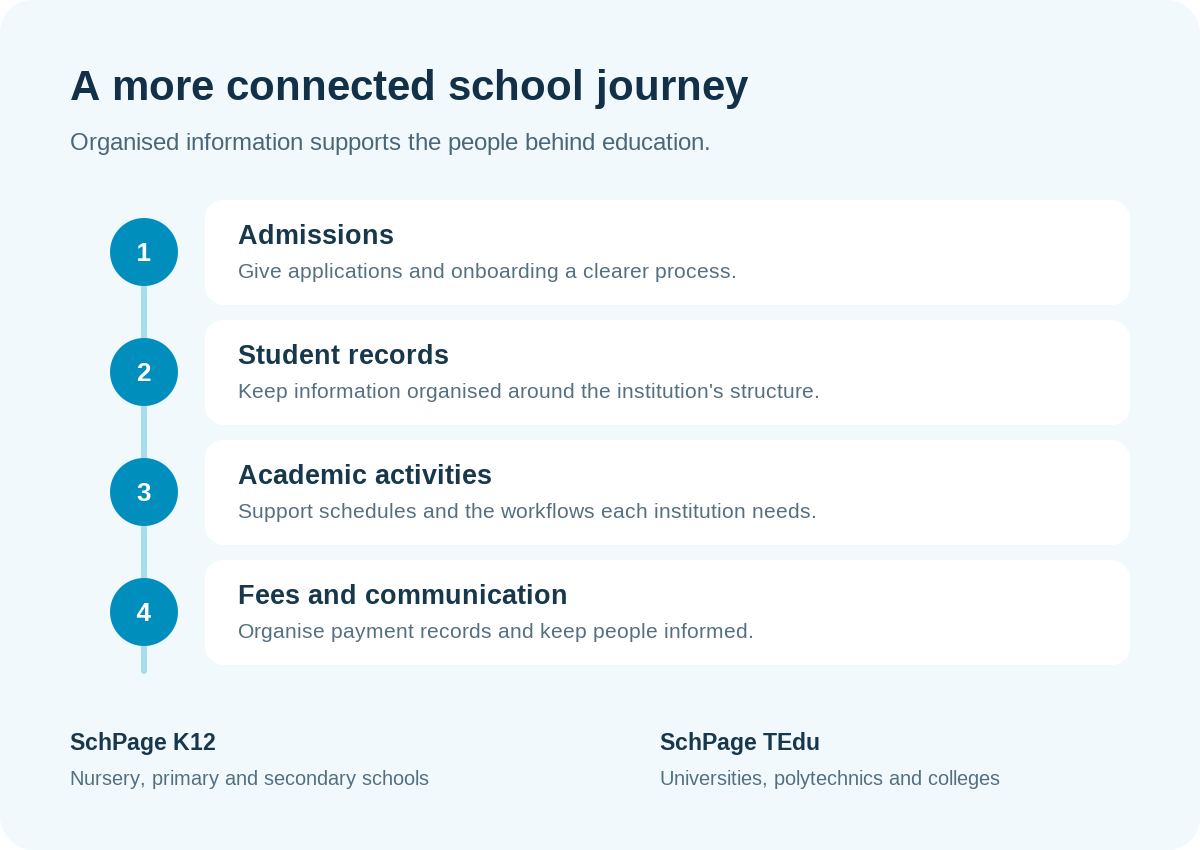
A connected school does not need to abandon human interaction. It needs a dependable way for people to find and manage the information behind that interaction.
Imagine an admissions team following an application through the relevant steps, teachers preparing results using a consistent process, and administrators keeping fee records organised. At a tertiary institution, imagine departments managing course registration and academic schedules around a shared institutional structure.
SchPage supports these workflows while leaving the important decisions with the people who know their students and their institution. Let us look more closely at the problems it is designed to address.
1. Making admissions less stressful for everyone
The admission process is often a family’s or student’s first meaningful experience of an institution. They may be excited, nervous and full of questions: What do I need to submit? What happens next? When will I hear back?
Behind the scenes, staff may be handling forms, checking documents, arranging assessments and preparing admission letters. If each step is tracked separately, it is easy for a request to get delayed while someone searches for the right file.
How SchPage helps
SchPage K12 supports online applications, entrance exams, interviews, waiting lists and admission letters. These capabilities give nursery, primary and secondary schools a more structured way to manage the admission journey.
SchPage TEdu supports admissions, registration and student onboarding, including document uploads and student records. It is designed around the needs of tertiary institutions, where students move into faculties, departments and levels.
A well-organised process cannot answer every question automatically or replace a helpful admissions officer. It can, however, make it easier for the team to see what needs to happen and give applicants a clearer experience.
2. Giving student information a more dependable home
A student record is more than a name on a list. It can connect a learner to an admission history, a class or department, and the information staff need to carry out their responsibilities.
When those details are spread across several files, a simple update may require multiple people to make the same change. If one copy is missed, staff can be left wondering which version to trust.
How SchPage helps
SchPage helps institutions organise student information within the context of their work. K12 schools can structure their sessions, terms, classes and arms, while tertiary institutions can organise faculties, departments and student levels.
A shared system is most useful when the information inside it is maintained carefully. Institutions should decide who is responsible for updates, limit access to the people who need it and regularly check records for accuracy.
3. Helping teachers spend less time calculating results
The end of a school term can be a demanding period. Teachers gather continuous assessment scores, enter examination marks, check totals and prepare report cards. They also need to make sure the final information reflects the school’s assessment policies.
When calculations are repeated manually across many students and subjects, even a careful teacher can face hours of checking and correction. That time competes with lesson preparation, student support and the many other responsibilities teachers carry.
How SchPage helps
SchPage K12 supports flexible assessment setups, automatic result computation and branded PDF report cards. Schools can use these tools to make repetitive calculations and report preparation more consistent.
Teachers and administrators remain responsible for entering accurate scores, reviewing results and applying the school’s policies. Technology can handle part of the workload, while educators continue to provide the judgement and care that numbers alone cannot capture.
4. Turning attendance records into a starting point for care
A missed day of school can happen for many reasons. A child may be unwell, a family may be dealing with a difficult situation, or a learner may be struggling in ways that are not immediately visible.
Recording attendance consistently helps a school notice when follow-up may be needed. But if registers are difficult to locate or compare, it can take longer to build a clear picture.
How SchPage helps
SchPage K12 supports daily attendance registers for class arms and branches. With organised records, authorised staff have a better starting point for reviewing attendance and deciding when to reach out.
A register cannot explain why a child is absent. A caring conversation with the family remains essential.
5. Bringing more clarity to fees and payments
Financial conversations can be uncomfortable for schools and families alike. A parent may believe a payment has been made, while the accounts team is still trying to match it to the correct record. An administrator may need to confirm an invoice before a question can be resolved.
At a tertiary institution, students may also be navigating different obligations, including acceptance, school and hostel fees. Unclear records can turn an already stressful period into a frustrating one.
How SchPage helps
SchPage K12 supports fee structures, invoices, payments and expense tracking. SchPage TEdu supports school, acceptance and hostel fees, including online payments, instalments and receipts.
By keeping relevant financial information organised, staff can spend less time searching through disconnected records and more time resolving questions. Institutions should still reconcile payments, explain their policies clearly and provide a way for people to raise discrepancies.
6. Helping the right people stay informed
A school depends on many relationships: teachers and administrators, schools and guardians, students and their institutions. When information passes through too many informal channels, important details can be overlooked.
A busy parent may miss an announcement in a crowded messaging group. A staff member may not know that a timetable has changed. A student may be unsure where to look for information about a process.
How SchPage helps
SchPage K12 provides dedicated portals for administrators, staff, students and guardians, with announcements. These portals give schools a place to organise information for the people involved in school life.
Digital communication works best when it is supported by clear guidance and accessible alternatives. Schools should consider internet access and the needs of their community, particularly when communicating important or time-sensitive information.
7. Organising the complexity of a tertiary institution
A university, polytechnic or college is not simply a larger secondary school. Its academic structure brings different responsibilities: faculties, departments, course requirements, credit units, lecturers, venues and student levels all need coordination.
A student registering for courses may depend on several offices working from consistent information. A department preparing a timetable must consider courses, lecturers and available venues. When these processes are disconnected, a small change can generate confusion across campus.
How SchPage TEdu helps
SchPage TEdu is designed for universities, polytechnics, colleges of education and other tertiary institutions. Its capabilities include:
- Faculties and departments: Organise the institution and assign students to departments and levels.
- Course registration: Manage courses, credit units, prerequisites, add/drop registration and lecturer allocation.
- Academic scheduling: Organise the academic calendar, lecture schedules, timetables and venue allocation.
- Admissions and records: Support onboarding, document uploads, student IDs and level tracking.
- Fees: Manage school, acceptance and hostel fees, including online payments, instalments and receipts.
- Alumni management: Maintain a connection with graduates after convocation.
The aim is to help the institution coordinate its work around the way a campus actually operates. Staff still need to review information, resolve scheduling issues and apply their institution’s academic rules.
SchPage K12 and SchPage TEdu: built for different learning environments
Both products address the need for more organised education administration. The difference is in the institutions they are designed to serve and the workflows those institutions use every day.
| SchPage K12 | SchPage TEdu | |
|---|---|---|
| Designed for | Nursery, primary and secondary schools and school groups | Universities, polytechnics, colleges of education and other tertiary institutions |
| Academic structure | Sessions, terms, classes and arms, including multiple campuses | Faculties, departments, courses, credit units and student levels |
| Everyday priorities | Admissions, attendance, results, report cards, fees and guardian access | Admissions, student records, course registration, timetables and fees |
| People involved | Administrators, staff, students and guardians | Administrators, lecturers and students |
Both products also include a built-in AI assistant intended to help their users find answers and complete everyday tasks faster. The right product depends on your institution’s structure and priorities; the SchPage team can help you discuss the fit.
What different people stand to gain
A school management system touches more than one office. Its value comes from how it helps people work together.
School owners and leaders
Leaders need reliable information to understand how their institution is operating. More organised records can make it easier to follow key processes, support staff and make decisions with context instead of relying on a chain of hurried phone calls.
Teachers and lecturers
Educators have limited time and many responsibilities. Structured records, timetables and, for K12 schools, result computation can help reduce repetitive administration. The time and attention saved can be directed toward teaching, preparation and student support.
Administrators and finance teams
Admissions, student records and payment queries require accuracy and coordination. A more connected workflow gives staff a clearer place to manage their work, investigate questions and hand tasks between colleagues.
Parents and guardians
Families want to know that their children are supported and that important school matters are being handled well. A dedicated K12 portal and clearer communication can help guardians stay connected to the school community.
Students
Students benefit when the processes around their education are easier to navigate. For tertiary students especially, structured onboarding, course registration and fee processes can help make a complex campus experience more manageable.
Introducing a new system without overwhelming your team
Buying software is only one part of the journey. The bigger change is helping people feel comfortable using it in their daily work. A thoughtful rollout can make a real difference.
- Listen to the people doing the work. Ask teachers, administrators, finance staff and other users where delays happen and what they need most.
- Agree on priorities. Decide which processes should be addressed first, whether that is admissions, records, attendance, results or course registration.
- Prepare existing information. Review records for missing or inconsistent details before transferring them into a new system.
- Set clear responsibilities. Determine who can view and update information, who will check its accuracy and who will help colleagues when questions arise.
- Train with familiar examples. Walk through real tasks, such as preparing a class list or recording a payment, so staff can see how the system supports their work.
- Communicate with your community. Explain what is changing, how students or guardians can get help, and what alternatives are available when someone cannot access a digital channel.
- Review and improve. Invite feedback, correct problems and adapt the process as people gain experience.
Before choosing a system, discuss implementation, pricing, training, data handling, backups and support with the provider. The best solution is one that fits both the institution’s needs and its capacity to use it well.
Frequently asked questions
Is SchPage only for large institutions?
SchPage K12 is designed for nursery, primary and secondary schools, including school groups. SchPage TEdu is designed for tertiary institutions. The right fit depends on your institution’s needs and circumstances, so it is worth discussing your requirements with the team.
Does SchPage replace teachers and administrators?
No. SchPage is designed to support their work. Educators and administrators remain responsible for decisions, relationships, checking information and handling situations that need human judgement.
Can SchPage help a school with multiple branches?
SchPage K12 supports multiple campuses and can be structured around a school’s sessions, terms and class arms. Discuss your particular arrangement with the team to understand how it would be set up.
Which product should a polytechnic or university explore?
SchPage TEdu is designed for tertiary institutions, including universities, polytechnics and colleges of education. It supports workflows such as faculties and departments, course registration, academic schedules and fees.
How should we prepare our existing records?
Start by identifying the records you want to bring across, checking them for accuracy and deciding who will verify the information. The transfer approach depends on the format and quality of your data and the scope of your implementation. Discuss the details with the SchPage team.
Better systems make room for what matters
The work of education is deeply human. It happens when a teacher notices a learner needs help, when a parent trusts a school with their child, and when a student finds support while navigating campus life.
Good administration helps those moments happen. When records are organised and routine processes are easier to manage, the people who run an institution have more space to focus on their community.
If you manage a nursery, primary or secondary school, explore SchPage K12. If you run a university, polytechnic, college of education or another tertiary institution, explore SchPage TEdu. You can also contact the Retenvo team to discuss your institution’s needs.