





Insights
Improve Your Business Processes Before You Automate Them
Understanding the work first leads to more useful automation and fewer avoidable surprises.
Retenvo Team ·

A faster process is not always a better process
When a team is overwhelmed, automation can sound like an immediate answer. But if nobody agrees on how a request should be handled, software may reproduce the same confusion at greater speed.
Begin by talking with the people who do the work. Ask them to walk through a recent example from the first request to the final outcome.
Find the decisions and exceptions
Document the information needed at each step, who makes decisions and where work waits. Pay particular attention to exceptions: a missing document, a disputed payment or a request that does not fit the usual rules. These cases often reveal why a process is difficult.
Remove unnecessary steps and clarify responsibilities before deciding what should be automated. Some decisions will still need a person’s judgement or approval.
Test a focused improvement
Choose a narrow workflow, define the expected result and test it with ordinary and unusual cases. Measure whether it saves effort without creating new problems for customers or staff. Retenvo helps organisations design and integrate automation around practical workflows.
Putting the ideas into practice
A finance team wants to automate invoice approval but different managers follow different rules. The following example shows how the team could turn the advice into a practical plan. The details will differ for each organisation, but the sequence gives everyone a shared starting point.
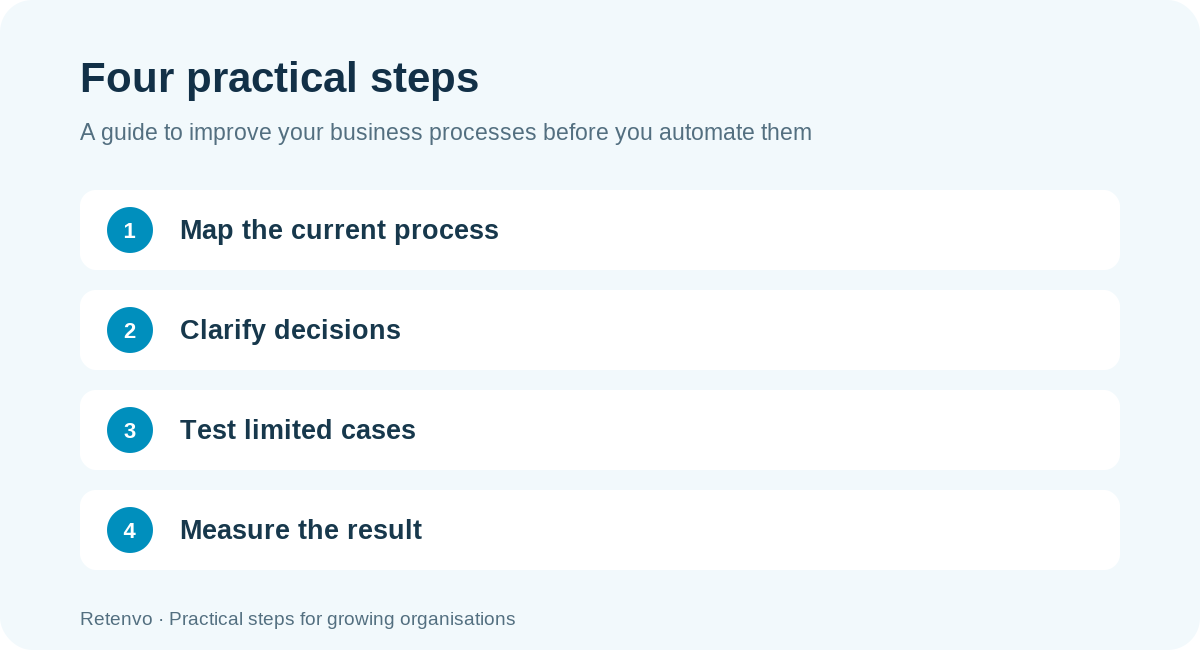
A pilot should have a defined task, representative examples and a clear point for human review. Include incorrect, uncertain and missing answers in testing and protect access to the information involved.
- Choose a focused task. Document the current steps, decision-makers, information needed and common exceptions.
- Set access and sources. Agree a clear process and identify which decisions need a person to review or approve them.
- Test and review. Start with a limited set of cases and test incomplete information, duplicate requests and errors.
- Improve before scaling. Compare the new process with the old one and ask staff whether it actually removed work or created new problems.
What to include in an AI pilot
Clear scope and sources: Choose a narrow task and agree which documents or systems the tool is allowed to use. Check who can access that information and who is responsible for keeping it current.
Evaluation and oversight: Prepare examples that cover correct answers, ambiguous requests and situations where the answer is missing. Decide when an employee must check an output or approve an action, and provide a route to human help.
Ongoing review: Collect feedback from the people using the tool and measure the effort involved in checking its work. Address inaccurate answers, outdated sources and access issues before expanding the pilot. Review relevant privacy and security requirements for the information involved.
Explore our services or contact the Retenvo team to discuss your needs.