





Insights
Using AI Assistants With Human Oversight
Plan a focused AI assistant around trusted information, review and clear boundaries.
Retenvo Team ·

A helpful assistant needs a clear job
An AI assistant can help a team search information or prepare a response, but it should not be treated as a source of unquestionable answers. The most useful starting point is a specific task with a clear audience and a way to judge the result.
For example, a support team might explore an assistant that helps staff find relevant information in approved internal documents. A person can then check the answer before responding to a customer.
Set boundaries before scaling
Decide which sources the assistant may use, who can access them and how sensitive information should be handled. Provide a route for the assistant to indicate uncertainty and for users to find human help. Any action with meaningful consequences should have an appropriate review and approval process.
Test with representative questions, including examples where the answer is missing or the request is ambiguous. An answer that sounds confident is not necessarily correct.
Measure and improve
Review accuracy, usefulness and the time people spend checking outputs. Gather feedback from users and update the underlying information when it changes. Retenvo helps organisations explore focused AI pilots and integrate assistants into existing workflows.
Putting the ideas into practice
A support team wants help finding answers in its internal guidance before replying to customers. The following example shows how the team could turn the advice into a practical plan. The details will differ for each organisation, but the sequence gives everyone a shared starting point.
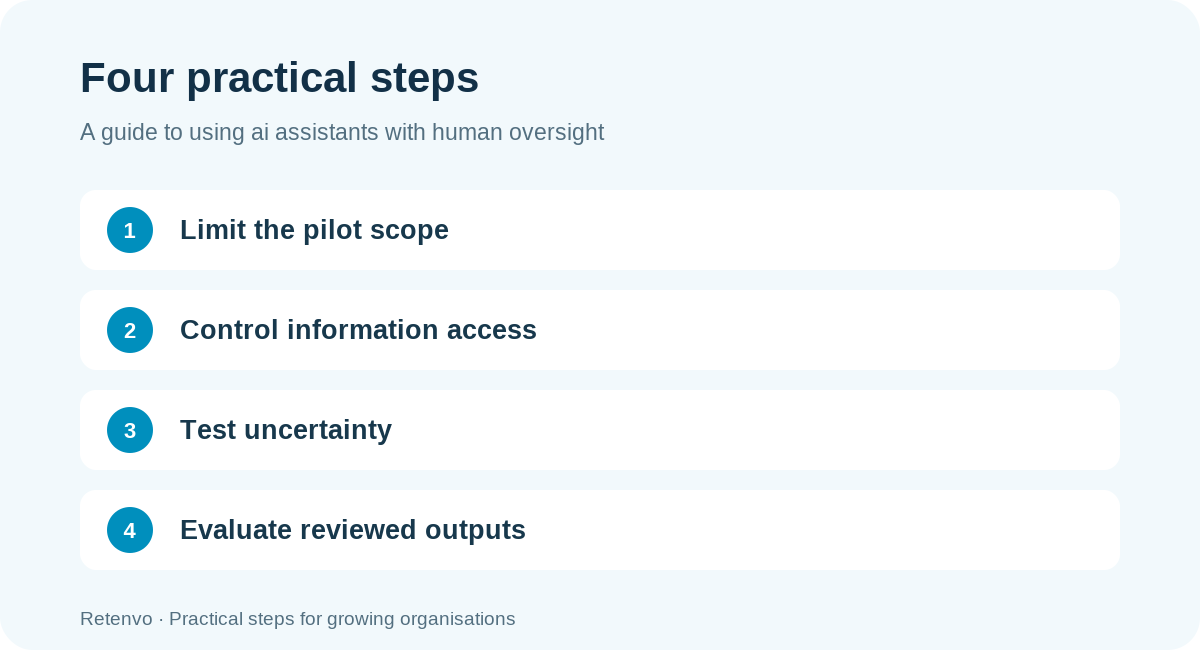
A pilot should have a defined task, representative examples and a clear point for human review. Include incorrect, uncertain and missing answers in testing and protect access to the information involved.
- Choose a focused task. Limit the pilot to a defined set of questions and approved, current source material.
- Set access and sources. Decide who may access the information and when a person must review an answer before it is used.
- Test and review. Test inaccurate, ambiguous and unanswerable questions as well as routine examples.
- Improve before scaling. Record feedback and evaluate usefulness after review time, not just the speed of the first response.
What to include in an AI pilot
Clear scope and sources: Choose a narrow task and agree which documents or systems the tool is allowed to use. Check who can access that information and who is responsible for keeping it current.
Evaluation and oversight: Prepare examples that cover correct answers, ambiguous requests and situations where the answer is missing. Decide when an employee must check an output or approve an action, and provide a route to human help.
Ongoing review: Collect feedback from the people using the tool and measure the effort involved in checking its work. Address inaccurate answers, outdated sources and access issues before expanding the pilot. Review relevant privacy and security requirements for the information involved.
Explore our services or contact the Retenvo team to discuss your needs.