




Insights
What Makes a Brand Identity Useful?
A practical guide to creating a recognisable brand identity that works beyond a logo.
Retenvo Team ·

Your brand appears in more places than you think
A customer may meet your business on a sign, a receipt, a website or a social post. If each looks and sounds like a different organisation, recognising you becomes harder. A thoughtful identity gives these touchpoints a shared language.
A logo is part of that language, but it is not the whole story. Colour, typography, imagery and the way you communicate all help people understand your business and remember it.
Start with the people you want to reach
Before choosing colours or drawing a mark, define your audience, your services and the impression you want to make. A children’s learning centre and a professional services firm may both want to appear trustworthy, but they can express that quality in very different ways.
Test ideas in the places they will actually be used. A logo should work on a phone screen and on a printed document; colours should leave text readable; templates should be easy for your team to use.
Make consistency achievable
Document the essentials: logo variations, colours, type, spacing and examples of appropriate use. Share usable files with the people who create your materials. Retenvo works with businesses on identities and practical design assets that can be applied across their customer touchpoints.
Putting the ideas into practice
A growing food business needs its packaging, receipts and online presence to feel like they belong to the same organisation. The following example shows how the team could turn the advice into a practical plan. The details will differ for each organisation, but the sequence gives everyone a shared starting point.
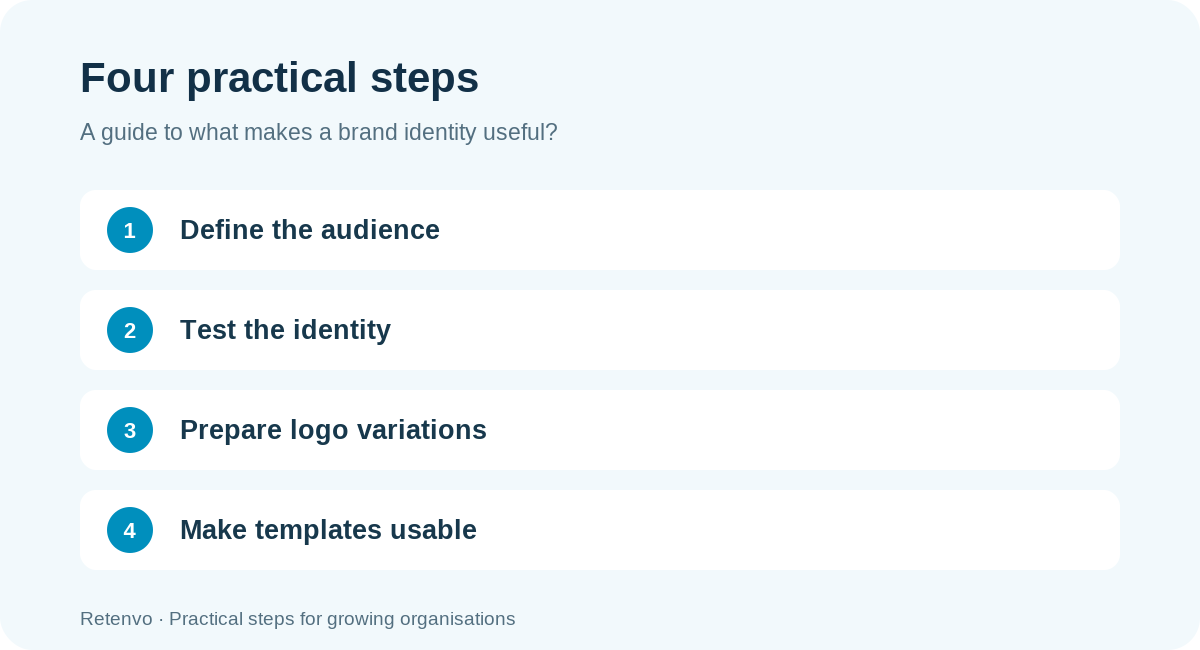
A usable identity needs more than a final logo file. Agree on the formats, templates and examples your team will need, then check the identity in the places customers actually encounter it.
- Define the audience. Identify the audience and the qualities the business wants its communications to convey.
- Create the identity. Test the proposed identity on packaging, a small screen and a simple document before finalising it.
- Apply it consistently. Prepare usable logo variants, colour values and type choices for both print and digital use.
- Review and update. Provide examples and templates so staff can apply the identity without reinventing it for every task.
How to put an identity to work
Make assets easy to find: Store approved logo files, colours and templates where the people creating materials can access them. Name the files clearly and explain which versions are suitable for print, dark backgrounds and smaller digital spaces.
Test real applications: Review the identity on the materials the business actually uses, whether those are a shop sign, an invoice, product packaging or a social profile. Check readability, image quality and whether the business name and contact details are consistent.
Maintain the system: Give someone responsibility for answering brand questions and updating shared files. When a name or contact detail changes, list the customer touchpoints that need to be updated, including older templates and printed materials.
Explore our services or contact the Retenvo team to discuss your needs.